
 Credit: http://www.billyyeager.com / Scene from the film Jimmy’s Story
 Credit: XS Magazine, Jimi Hendrix and Jimmy Story
 Credit: www.billyyeager.com Image from the film Jimmy’s Story (Jimmy Page, Jimmy Story, Carlos Santana, and Pete Townsend)
The music was astonishing. Jimi Hendrix’s drummer Mitch Mitchell stated:

“Working with Jimi, listening to him jam, rehearse, write music, I know if I hear a song that was composed by Hendrix; I can tell instantly, from phrasing, chord structures, movements from bridge to chorus, etc. I can tell you, these songs cannot be faked.
Jimi was working on music before he died called the Bolero Tapes. If this is the music and this is his son, from the musical stand point, there is no question about it. You can fake a guitar, maybe a little of his voice, but lyrics, and melody, it’s not possible, from what I hear this kid is the real deal.” – Mitch Mitchell
Activist / Performance Artist

Due to the stories published by XS Magazine and The Miami Herald Billy Yeager’s Jimmy Story performance artwork could be misconstrued by some as nothing more than a superficial prank. But underneath the ludicrous exterior, the musician propping himself up as the joker, making the audience laugh, was in fact not a joke at all; Jimmy Story’s Performance art Piece was a protest statement against our superficial pop culture and the mainstream media that turns a blind eye and dupes people by publishing sensational stories.
No matter how ridiculous a story is, as long as they can create headlines, it’s “fit to print.”
XS magazine featured Jimmy Story on their cover. It was obvious that they never believed Jimmy Story was the son of Jimi Hendrix, as they admitted in a interview with the Miami Herald, but still the magazine chose to run the story because they thought it would be a good story.

Credit: http://www.billyyeager.com / South Florida’s weekly XS Magazine
“Undoubtedly, Story’s guitar playing is extraordinary. It’s certainly influenced, if not genetically driven, by Hendrix. It’s Story’s voice that is most convincing, a deep, mumbling inflection that will cause most listeners to do a double-take.” – Bob Weinberg / XS Magazine
Bob Weinberg was the journalist that wrote the feature article “Voodoo Child,” the story behind the secret son of Jimi Hendrix.
Billy Yeager and Glenn DeRosa were surprised to see Jimmy Story featured on the cover of XS.
Yeager got in contact with Bob Weinberg again for a follow up story.
Billy and Bob spent the entire day and early evening together. Yeager explained the role of Jimmy Story’s performance artwork within the context of the movie; he even showed Bob some raw footage from Jimmy’s Story and also played him some music from The Lost Bolero Tapes.
“When Bob Weinberg returned with his follow up story, he explained to his editors that Billy had been making a film, and also that he was a pretty kool guy; Bob personally felt that there was no harm done, and this really upset his editors.
They made the decision to replace Bob and assigned another journalist to get “the facts.” They brought in a hard-nosed female reporter who agreed to meet Billy, and right from the get go, things did not go well.” – Glenn DeRosa
Yeager walks out of the interview
XS wrote: “Yeager walked out of an interview with an XS reporter. Yeager ended the Q&A session when the reporter informed him we weren’t interested in his life story, that we only wanted to know what he had hoped to accomplish with this fraud.”

“When Billy began to explain the film Jimmy’s Story and what his performance piece was all about, the journalist answered very rudely, ‘I am not interested in hearing about your life story,’ and Yeager walked out and sent XS a fax with a riddle. They made a huge mistake; for them to understand Jimmy Story, they needed to understand Billy’s life story and film. They didn’t want to hear the truth, they had an agenda, Bob had the truth, they didn’t want that either.” – Glenn DeRosa
When XS magazine demanded an explanation for “his hoax,” Yeager took it even further with his performance art. Rather than trying to prove his case, in classic Yeager style, he answered with a defiant rebuttal, leaving the journalists even more perplexed.
Fax transcript:
“There once was a man who lived in a city of ignorance and the people were blinded. Although he offered those who did not understand some water and to remove the veil from their eyes, they resisted. Pause and wonder oh blind little sheep. My ways are too grand for such feeble minds, send me someone with wisdom and then shall I speak. In the meantime, I wipe my butt with peoples’ feeble thoughts of what they think of what I do, all is grasping for the wind, oh little town of wannabes. My farts are incensed with genius.” Jimmy Story / Billy Yeager
Instead of telling the truth about Billy’s film and the message of Jimmy’s Story performance artwork, XS magazine and the Miami Herald chose to publish stories referring to Jimmy Story as nothing more than a hoax and labeling Yeager as a fraud.

Credit: http://www.billyyeager.com / XS Magazine Retraction
The Miami Herald published a defamatory article against Yeager and DeRosa in support of XS magazine.

Credit: Glenn DeRosa
Glenn DeRosa is an environmental consultant and the owner of Waste to Energies, an alternative energy company located in Boston, MA. He was one of the actors and producers of Jimmy’s Story.
“The Miami Herald wrote that Billy Yeager claimed the hoax executed for attention, but we never said that. We explained to the Herald that it was performance art, and it was going to be edited into the film, it was not a publicity stunt, the truth was totally distorted.
When Billy reached out to me to play the manager in the film Jimmy’s Story, I was running 3 businesses, I had a wife, two children, I would not have become a part of a hoax and jeopardized my career.
Billy and I had these meetings every week, we would go over his notes and editing decisions, every person involved with film in South Florida, filmmakers such as Elliott Merles, friends, family, everyone knew he had a masterpiece in the making.”
– Glenn DeRosa
The Miami Herald wrote:

“They said we were ‘taking the hoax to Europe.’ I never said that, that is a lie. I mentioned Europe because I had an associate that wanted to bring Jimmy’s Story to the Cannes Film Festival, but notice how they twisted it? How could you ‘take a hoax to Europe’? If there is a hoax, doesn’t everyone know there is a hoax, especially since the Herald just announced it?” – Glenn DeRosa
But journalist John Barry “believed” Billy Yeager’s Jimmy Story Performance Artwork should be taken “very seriously” and felt it was necessary to contact the State’s Attorney to ask if a crime had been committed.
 Credit: www.billyyeager.com / The Miami Herald’s article
The Miami Herald wrote: “The state attorney’s Dade Crime Unit says Yeager and DeRosa broke no laws by fooling the media.”

Glenn DeRosa: “Calling the state’s attorney was ludicrous in my opinion. When that story was published my office was located in Miami Beach at that time, just a few blocks away. I went right into their offices and demanded that the article be retracted. I said, ‘These are lies, you knew Billy was making a film.’ They gave me the run around and said they would publish a retraction, but they never did.”
The retraction notice written by XS Magazine is full of inconsistencies and contradictions; they stated that Jimmy Story was nothing but a hoax created by a frustrated and embittered musician, yet they also state that Yeager “was correct” and “proved his point” in that “celebrities are more revered than artists, that being famous doesn’t equate to being talented, that the “lost son” of Jimi Hendrix could get more attention than a local musician.”
When XS asked Miami New Times former journalist Greg Baker for his thoughts on what Yeager was trying to achieve as Jimmy Story, Baker explained, “I think Yeager wanted to use the media to achieve that end, tearing down the corrupt media industrial complex, which is contributing to the downfall of society, I am all for this sort of thing. I don’t think anybody did anything wrong.”
Stephen Wissink was the publisher for XS Magazine and was in charge of making the decision of how to respond to their readers. In Wissink’s apology and retraction, he thought it would be best to tar and feather Yeager, describing him as frustrated, embittered, angry, which is ironic because it is actually Wissink who is embittered; in his own words he states: “Hell hath no fury like a journalist who has been duped.”
But there is more than meets the eye about the credibility of XS and its staff; if I’ve ever tasted bitterness more than this, it was a brussel sprout milkshake: CLICK.
The truth is that after running the story Wissink felt embarrased for the criticism XS magazine received from other publications, but his own words prove they always knew Jimmy Story was not the real son of Jimi Hendrix, and they chose to run the story anyways.

Referring to Jimmy Story, Bob Weinberg wrote in his story for XS Magazine, “Oddly, he’s most lucid when quoting scripture.”
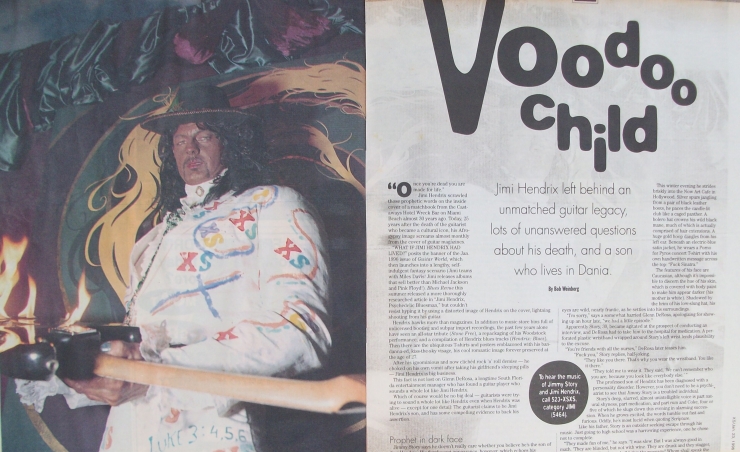

Yeager hand painted the gospel of Luke, chapter 3, verses 4, 5, and 6 on his pant leg.
Luke 3: 4-6
4 As it is written in the book of the words of Isaiah the prophet:
“A voice of one calling in the wilderness,
‘Prepare the way for the Lord,
make straight paths for him.
5 Every valley shall be filled in,
every mountain and hill made low.
The crooked roads shall become straight,
the rough ways smooth.
6 And all people will see God’s salvation.’”
In the liner notes on the back cover of Yeager’s album Be My Valentine, which was manufactured in 1985 (12 years before the first version of Jimmy’s Story was completed), it states:
“And Jimmy Story is the world’s best kept secret.”
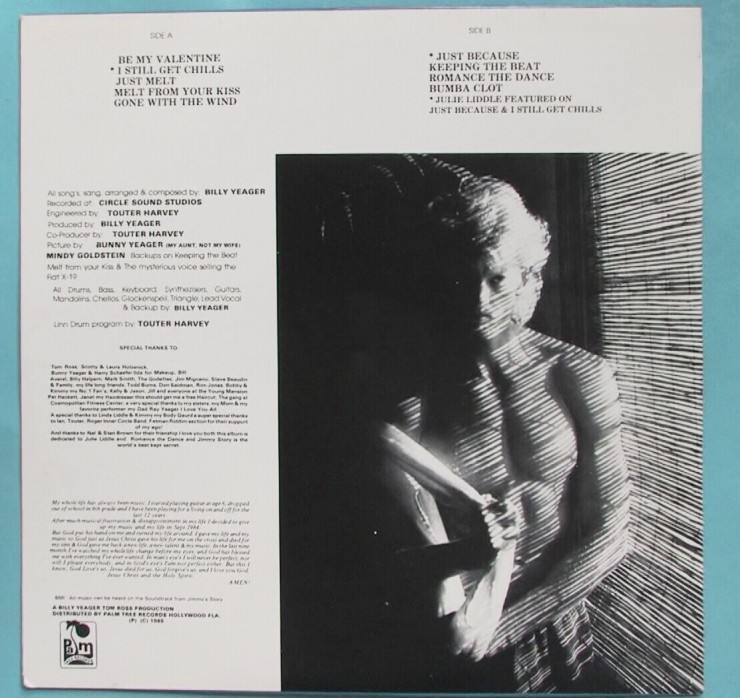 Photo by Bunny Yeager / Be My Valentine (1985)
“In 1985, Yeager already knew he was going to become Jimmy Story and make a movie, so in no way did Yeager ever create just a meaningless hoax ‘to vent his hostilities upon XS Magazine because he was embittered.’ They were the ones embittered because they didn’t like the fact that Yeager had proved his point about the media through them.” – Glenn DeRosa

Jimmy’s Story / The Movie

The Making of Jimmy’s Story
Yeager’s film Jimmy’s Story gained the attention of one of the most powerful men in independent film, John Pierson. John had previously discovered Spike Lee, Michael Moore, and Richard Linklater — he had also repped and sold films, such as Roger and Me and She’s Gotta Have It, at the Sundance Film Festival.

John produced a segment about “The Making of Jimmy’s Story” featuring it on his television show Split Screen.

Credit: Split Screen Dan Myrick, renowned co-creator and director of the The Blair Witch Project, was hired to film and edit the segment, which was a big hit on Bravo television.
Dan and Billy became instant friends. Throughout the years, Myrick has been a stalwart supporter of Yeager and his work.

Credit: Time / Newsweek / Daniel Myrick and Eduardo Sanchez and their Blair Witch Project phenomenon
Jimmy’s Story – Part 1 was completed in 1996. The film was first discovered by Award Winning filmmaker Rick McKay who produced and directed the award winning documentary film Broadway: The Golden Age.

Rick McKay was staying at the Gulf Stream Hotel in Lake Worth, Florida, while he was attending the premiere of his film Broadway: The Golden Age at the Palm Beach International Film Festival.
Rick had just finished his breakfast and reading a newspaper article about Jimmy’s Story, when he stepped outside and saw Billy Yeager walking down the sidewalk heading towards the beach.

Credit: Getty Images Filmmaker Rick McKay
Rick introduced himself and told Billy about his film Broadway: The Golden Age and asked him if he could watch Jimmy’s Story. Later that day, Billy dropped off a VHS copy of his movie at the Gulf Stream Hotel for Rick and forgot all about it.
A week later, Rick told Billy he had secretly submitted Jimmy’s Story to the director of the Dahlonega International Film Festival, Dean Treadway.
Dean Treadway instantly fell in love with Jimmy’s Story and was already planning to award the film in several categories.
Credit: Dean Treadway
“Out of the 700 films submitted, Jimmy’s Story is the one that moved me most to tears of joy and frustration.” – Dean Treadway
Dean called Billy wanting to know if he would be attending the festival, but he was also hoping that Yeager would want to speak with other filmmakers at film panels and seminars about the making of his film.

Credit: Gary Brice / Billy Yeager and Rick McKay at The Palm Beach International Film Festival
Jimmy’s Story received an unprecedented 4 awards with standing ovations — it was evident that Yeager had created something profound and revolutionary.
Jimmy’s Story is a combination of several film genres: documentary, mockumentary, pseudo-documentary, docufiction, cinema verite. The term “mockumentary,” which originated in the 1960s, was popularized in the mid-1980s when Rob Reiner used the term to describe the film This is Spinal Tap.

Jimmy’s Story has been described as “a tour de force” and “epic in scale.”
Dean Treadway (director at the DIFF Film Festival) stated, “This great film, this near masterpiece of amateur filmmaking, a Sundance reject that deserves to tower above most of their eventual winners, is about one man’s perseverance in believing that there is a better future out there, one that has him doing exactly what he feels he’s meant to do.”
In Dean Treadway’s 2003, The Year in Review, he lists Jimmy’s Story as one of the best films of 2003, alongside other highly acclaimed films such as The Barbarian Invasions, 21 Grams, Mystic River, A Decade Under The Influence, Kill Bill, and The Corporation.
That is quite an honor — especially considering this was Yeager’s first film.
Jimmy’s Story begins with a quote from the book of Ecclesiastes, and ends with a quote from Ecclesiastes; the film is about a man’s desire to discover his purpose and the meaning of life.
Although scriptures are mentioned throughout his films, and on the back covers of his record albums from 30 years ago, Yeager subscribes to no label or isms, and does not adhere to any form of organized religion.

 Jimmy's Story, a film by Billy Yeager